
IOER, then IORB when reserve requirements were dropped, was introduced in the Emergency Economic Stabilization Act of 2008. “The Emergency Economic Stabilization Act of 2008 (EESA) accelerated the authority for the Federal Reserve to pay interest on depository institutions’ reserve balances. It moved the effective date forward from October 1, 2011, as originally scheduled in a 2006 act, to October 1, 2008. ” The 2006 Act, the “Financial Services Regulatory Relief Act of 2006“, was passed with the ability of the Fed to pay interest on reserves in order to level the playing field between small and large banks. It was meant only for required reserves as the legislative history of its author, Idaho Senator Mike Crapo, makes clear. All previous academic literature including Fed literature on this was for the payment of interest only on required reserves. These required reserves were only 1% of all deposits when the 2008 crisis hit. The reserve drawdown during the bank run of 2008 led to negative Fed reserves not counting liquidity swaps. So the problem was that even though the 2006 Act is designed for interest on required reserves, when it was written up it states that the Fed can pay “interest on reserves”. It did not include the word required even though that was the intent. Given the negative reserves of 2008, the Fed decided to have the legislative effective date moved up to asap in 2008, and then decided to pay interest on all reserves. This has led to the subsequent buildup.
Warsh could implement one major policy reform of what was enacted in 2008
Warsh could implement one major policy reform of what was enacted in 2008: Stop paying interest on reserves. This has caused the Fed to lose billions, has paid the large banks the seigniorage that should have been given back to Treasury at the end of each year, and has set interest rates in markets. By ending the payment of interest on reserves, the $trillions in reserves will gradually be drawn down, and the interest rates will be determined once again in capital markets rather than by dictate of the Fed. If you look at this interest rate on reserves at IORB on FRED, and also the previous name for this rate of IOER for earlier years from 2008-2021 (IOER on FRED), you will see it sets all of the short term rates in the markets. This is like the Soviet Union setting the price of bread, but now it is the Fed setting interest rates sometimes way too low or too high.
Real Oil Prices and Inflation
People like to blame oil prices for causing inflation even though it is the other way around, with money supply growth causing inflation. This graph shows the relation between nominal oil prices, real oil prices and the normalized US CPI inflation rate. Very close correlation between oil prices and inflation. Two main exceptions: the increased demand from China post-WTO entry in Dec. 2001, up to the 2008 crash, and second, the sterilization of reserves through the Fed suddenly paying interest on reserves for the first time in history, from 2009-2015, after which the Fed finally began deregulating capital markets by letting the interest rate on reserves rise.
Keep in mind that the Ukrainian war started after US inflation was already at 7.95% in February 2022.

AS-AD with Relative Prices
Why not use the real AS-AD model that is derived from Ramsey (1928)? Keynes would be proud.
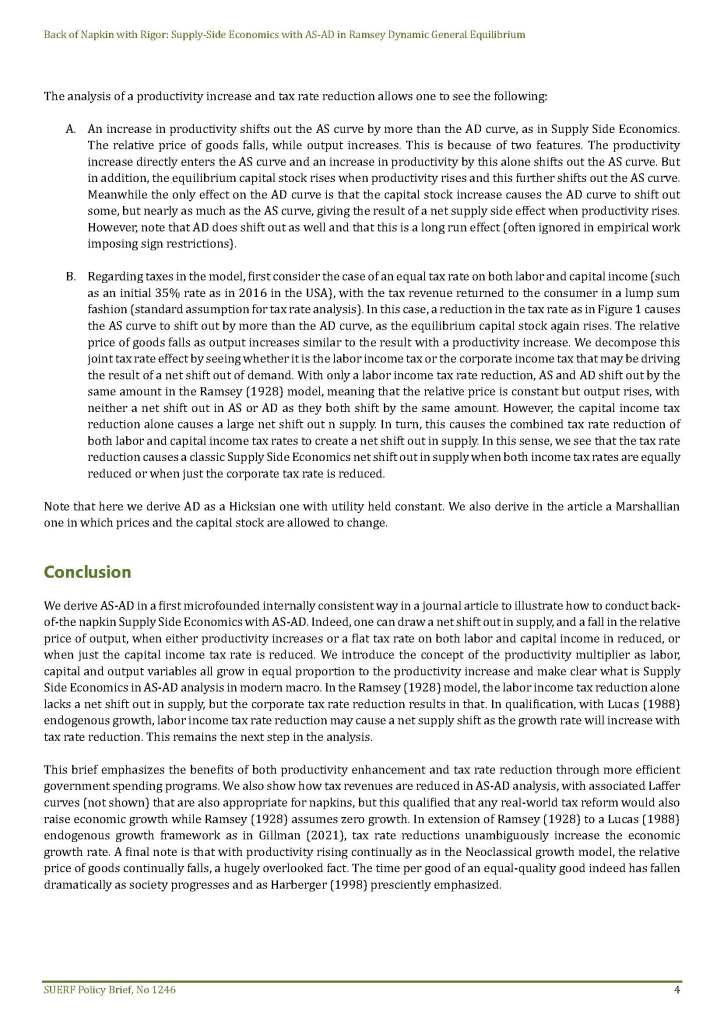
Here is a SUERF Policy Brief draft to be published in September.



Granger predictability of real oil prices by US money and inflation in Markov-switching regimes” has been published online in Eurasian Economic Review, Open Acces
rdcu.be/d7wKW
Present value theory linking oil prices to money growth and inflation rates: The model presented here is a theoretical asset pricing model for oil prices from Gillman and Nakov (2009). It shows that the capital in the oil sector demands that the USD oil price follow changes in the discount factor which is the nominal interest rate. The model includes how the nominal interest rate can be written in terms of the inflation rate and also the money supply growth rate.
Greg Ip is Right: “Why the Fed Should Cut Rates Now – Not Wait Until September”
Williams is Wrong Again
According to the WSJ today (Nick Timiraos, July 17, 2024), John Williams as President of the New York Fed and Vice Chair of the Federal Open Market Committee (FOMC) that decides US monetary policy, stated that the labor market’s current conditions (a slow, steady rise in the unemployment rate) and recent inflation rates are “getting us closer to a disinflationary trend that we’re looking for…These are positive signs. I would like to see more data to gain further confidence inflation is moving sustainably to our 2% goal.”
First of all, Williams is famous for his 2003 academic research paper that stated that the US economic growth rate was in a steady 60 year decline and that Zero market interest rates were justified for the indefinite future. [1] He repeated this mantra of low and ever-falling economic growth as recently as a 2017 journal article stating that this same thesis was true internationally amongst a host of other developed nations as well.[2] No growth forever was his theme and it was taken to justify indefinitely low to zero market interest rates even as inflation was positive, say around 2%. This meant negative real interest rates: a market rate of say zero minus an inflation rate of 2% gives a negative real interest rate (after inflation) of -2%. So Williams first justified Greenspan’s negative real rates after the 2001 terrorist attacks and recession, and again after the 2008 crash and right up to 2017. Williams is a PhD student of renown Professor John Taylor and both are leaders of the New Keynesian economic school of thought.
Yet in 2016, with Trump as President, and with him berating the Fed for financial repression, Yellen and then Powell raised interest rates until we finally had 11 months of positive real interest rates in 2018-2019, and a steadily rising economic growth rate. Output growth came in at 4% around that time. Clearly, ever-declining economic growth was a Keynesian Myth that proved false as soon as Trump got the Fed to deregulate capital markets by stopping the prohibition of a positive real interest rate. Trump jawboned the Fed into ending an effective prohibition on usury, that is earning a positive real interest rate in capital markets, and economic growth responded.
So Williams’s famous articles on the “secular decline” of the US and other countries was a blatant falsehood led by misleading data work combined with a standard New Keynesian (NK) model. On that, I have written at length to explain how Williams and coauthors twisted like a pretzel data with theory to tell a Larry Summers “secular stagnation” story, despite its obvious implausibility given the then-recent booming decades of the 1990s and 2000s.[3] You can look up Summers version on his blog.
Williams was wrong then. Williams is wrong now. And again it is to justify arbitrary Fed action. Williams is a professional acquaintance of mine and seemingly a genuinely wonderful person; incredibly decent and responsible. But marching to a tune of the Fed’s discretionary control over markets rather than letting laws of the US Congress, which regulates the Fed, dictate Fed actions.
Why is Williams wrong again? The Fed has no authority to set the inflation target by itself according to statutory law of the 1978 Full Employment and Balanced Growth Act signed by President Carter that set a 3% inflation target by 1983, and 0% from 1988 onwards. Those targets can only be changed, according to the statute, by the President or by Congress, and not by the Fed. Yet in 2012 the Fed issued a statement, which I have written about at length.[4] In January of 2012, they stated:
“The inflation rate over the longer run is primarily determined by monetary policy, and hence the Committee has the ability to specify a longer-run goal for inflation. The Committee judges that inflation at the rate of 2 percent, as measured by the annual change in the price index for personal consumption expenditures, is most consistent over the longer run with the Federal Reserve’s statutory mandate (Board of Governors of the Federal Reserve System 2012).”
Fine; so they violated statutory law. Nobody but me seems to care. Although even Paul Volcker wrote in his last book shortly before his passing that a 2% inflation rate was not in any book that he knew of: [5]
“I puzzle at the rationale…A 2 percent target, or limit, was not in my textbook years ago. I know of no theoretical justification.”
However in the exact same 2012 statement the Fed stated that monetary policy will not consider labor markets, which also violates the 4% unemployment rate target that the same 1978 Act cited above set in law:
“The maximum level of employment is largely determined by nonmonetary factors that affect the structure and dynamics of the labor market. These factors may change over time and may not be directly measurable. Consequently, it would not be appropriate to specify a fixed goal for employment.”
Therefore, one could say that the Fed declared despite the 1978 Act that labor markets do not matter for Fed policy. Yet according to the WSJ, Williams implies that unemployment affects inflation. Williams is trying to keep interest rates high, despite what some on the FOMC would like, with an average real interest rate of about 2% for the last year, after 20 years of negative real interest rates that his New Keynesian models were used to justify. What model is Williams using now? That GDP growth cannot rise back up towards a sustained 2-3% that has been enjoyed in the US post-WWII period? No. Now, the secular stagnation NK theory that put Williams in the Fed drivers’ seat is past history and fully discredited by the facts of real GDP output growth being strong and resilient.
Instead, I guess Williams just likes to stick to his guns that no rates would be cut until September, even if real estate markets are crashing with distress as they are now.
From overly negative real interest rates based on NK theory to overly positive real rates based on no theory, I guess Williams’ Fed just likes to control market interest rates, just for the sake of control. Rather than letting markets determine real rates, the Fed seems to enjoy their newfound post-2008 ability to set market rates through the interest paid on bank reserves held at the Fed.
What is the Nobel prize (2004) accepted theory that determines market-based real interest rates: Real business cycle theory. During booms real rates rise to the 2-3% level in the 3-month Treasury market and during recessions these real rates fall down close to zero, but rarely ever are negative. Unless of course, the Fed sets by diktat market rates and drives them down to negative levels or keeps them at overly positive levels.
Why does the Fed do this? They were embarrassed by the high inflation episode we just experienced that they said was just going to be a blip, not an episode. It was a serious episode, in fact.
There are over $3 trillion in excess reserves sitting at the Fed and the Fed is terrified that banks will lend out this reserve money, over which the Fed has no control. Because, as the Fed knows, what causes inflation is not labor markets or oil prices or supply-chains; it is the growth rate of money supply that enters circulation that causes inflation.
The Fed cannot control the Frankenstein “ocean of reserves” that the Fed has induced to get non-FDIC insured banks to self-insure, to avoid another uninsured investment bank collapse as in 2008 that drove Fed reserves to negative levels: they ran out of money, a good joke for late night TV for economists.
The Fed does not want to lower interest rates because they do not know how much of the reserves will be lent out and cause higher inflation. There is no other possible reason unless they simply enjoy inflicting pain on the economy, or is it that they enjoy enrichening the investment banks holding the trillions of reserve dollars?
Renown professor John Cochrane wrote recently in the WSJ that the Fed’s ocean of reserves is good policy and paying interest on reserves is good policy. In other words, self-insurance by non-insured banks is better than government bank insurance policy that for example ended the Great Depression in March 1933 through the establishment of the Federal Deposit Insurance Corporation (FDIC, at first on a temporary basis, later permanent). Cochrane’s idea, and many other famous economists from Charles Goodhart to Thomas Hoenig, is that self-insurance is better than a good government bank insurance policy based on risk-based premiums as in private insurance markets and as in the FDIC scheme (Congress made the FDIC premiums risk-based by a 2006 Act). And this idea/argument is despite Bagehot’s (1873) famous treatise that relatively efficient bank insurance led England to be the center of global capital markets because the Bank of England pooled together private bank reserves and lent them out during bank runs as needed, so that less reserves were being held overall in the entire banking system as a result of the pooling. This is the opposite of self-insurance (as Bagehot described was the case for France at the time); it allowed more capital to circulate; and it made wealth accumulate more quickly.
The Fed in contrast cannot pool together the trillions in reserves held at the Fed because the Fed does not own any of those reserves. The Bank of England had reserves given to it willingly without any interest paid to them; the Bank could pool them to stem panics; and the Bank of England earned seigniorage as inflation tax revenue that financed its earnings. The Fed cannot pool the reserves; the Fed cannot use them to stem a bank panic; the Fed pays for banks to give it reserves; and the Fed no longer transfers its inflation tax revenue only to the US Treasury but instead since 2008 to private banks, arguably in violation of the Congressional Budget and Impoundment Control Act of 1974 and the Federal Credit Reform Act of 1990. All said, the Fed’s bank insurance scheme has turned Bagehot into Frankenstein.
But then what happens to such “good bank insurance policy” if it allows the Fed to control the exact level of real interest rates rather than letting markets do it? What happens to such good policy if it directs all of the US inflation tax seigniorage to private banks holding the reserves rather than to the US Treasury for revenue to finance Treasury spending? What happens to such good policy if it makes the Fed unable to control the inflation rate since they no longer control the rate of growth of money in circulation that determines the inflation rate?
[1] Laubach, T., & Williams, J. C. (2003). Measuring the natural rate of interest. Review of Economics and Statistics, 85(4), 1063–1070. https://doi.org/10.1162/003465303772815934
[2] Holston, K., Laubach, T., & Williams, J. C. (2017). Measuring the natural rate of interest: International trends and determinants. Journal of International Economics, 108(Suppl. 1), S59–S75. https://doi.org/10.1016/j.jinteco.2017.01.004
[3] “Lucas’s Methodological Divide in Inflation Theory: A Student’s Journey”, by M. Gillman, 2022, Journal of Economic Methodology, Volume: 29, Issue 1, January, pages 30 – 47. DOI:10.1080/1350178X.2021.2019818
[4] “The Welfare Cost of Inflation with Banking Time”, 2020, Max Gillman, BE Press Journal of Macroeconomics; Advances; De Gruyter, volume 20, Issue 1, January, pp. 1-20; DOI: 10.1515/bejm-2018-0059;
and Gillman, Max, The Spectre of Inflation, Agenda Publishing, UK, December 2022; Columbia University Press, US, Feb. 2023. https://www.agendapub.com/page/detail/the-spectre-of-price-inflation/?k=9781788212366; and https://cup.columbia.edu/book/the-spectre-of-price-inflation/9781788212373.
[5] Paul Volcker, Keeping at it: The Quest for Sound Money and Good Government (2018).
The Real Estate Run Has Begun, as the Fed sits in Nowhere land making Nowhere plans for Nobody.
As the Federal Reserve System sits on an Interest rate on Reserve Balances (IORB) of 5.4% that they set by dictate each time they meet for “monetary policy” decisions, the 3-month Treasury bill rate continues to follow it nearly identically. This is true even though the IORB is the rate the Fed began paying in 2008 for all reserves held at the Fed, which was first called the Interest on Excess Reserves (IOER). It became instead the “IORB” once the Fed dropped reserve requirements in 2020, since excess reserves had swooned to $4 trillion. All, despite the fact that the original 2006 Financial Services Regulatory Relief Act was passed to allow the Fed to pay interest to private banks only for the required reserves held at the Fed, not all reserves. (The idea was to level the playing field between small and large banks, since small banks had more reserves per deposits than large banks. Now large banks dominate the receipt of IORB payments).
Since the 3-month T-bill follows the IORB, let’s just use the IORB and see what the real interest rates are. The real rate is the residual of the market rate minus the inflation rate: what you get in interest after inflation when you lend capital.
The IORB rose above the inflation rate for the first time since Trump was President in April 2023 and has stayed above continually now for over a year. For this period from April 2023 to May 2024, the IORB averaged 5.31%, the inflation rate averaged 3.49%, and the real interest rate was by this measure 1.82%. This is after having a negative real T-bill interest rate for nearly every month from 2001 to 2023; there were about 3 years of positive real T-bill interest rates in these 22 years and 19 of negative real interest rates.
For the last 12 months, the IORB has averaged 5.36% and the inflation rate 3.32%, giving an average positive real interest rate of 2.04%, again after nearly 20 years of negative real interest rates.

The Fed’s abrupt change in policy rates, from driving the real rate negative for two decades to imposing a 2% real rate for the last year, can hugely distort markets. Now we see this Nowhere Man Fed policy driving the real estate market into distress. We finally have a run on real estate holdings after Starwood Capital Group capped withdrawals from its fund. Real estate investment trusts (REITS) as an industry whole face an amount of withdrawals that dwarf the amount of new deposits. This is how a run takes place in markets.
The Fed insists inflation is not low enough to cut rates, when all that matters is what the real interest rate is since this determines the cost of capital. Sitting in their Nowhere Land in Washington D.C., the markets are beginning to implode in the Everywhere Land of global capital markets.
FED: Lower Your Dictated Interest Rate Now; Real Rates have been above 2% for 7 months.
Last time I wrote how the last 6 months of CPI inflation at rates in the 3% range made shot the real interest rate up to over 2% for the entire period. Why? Because after almost a quarter of a century of the Fed pushing the real interest rate below zero (with 2006-2007, and a year over 2018-19 as the 3 years of exceptions), now the Fed is by declaration (of its “interest rate on reserve balances IORB”) causing a too high real interest rate designed in markets only for the best of times.
Inflation in December 2024 was 3.3%, making the average over the 7 months from June 2023-December 2023 exactly 3.3%. In contrast, the “IORB” has averaged 5.37%, set at 5.4% for the last 6 months to December. Well, the real interest rate is the market rate discounted for inflation, which means that you subtract the inflation rate from the market rate. This is an “implied” rate, while the market rate and inflation rate are known variables. We attribute this as the Fisher equation of interest rates from his 1896 PhD thesis, deriving the “real” rate of interest after accounting for inflation.
So 5.37% minus 3.3% is a real rate of 2.4%. Quite above 2%. Throughout postwar US history, we have had such high rates only during boom periods of the 1960s, 1980s, 1990s. The inflation rate averaged 6.6% from April 2021 to May 2023, not a good time for the economy, and not a time when we would want to follow up with suddenly high real interest rates. Now, do not mistake me for saying that a “normal” 2% real rate is bad; no, it can be good in good times and is expected in good times. But a Fed-enforced period of MINUS 1.9% (-1.9%) on average from the month after the 9/11 terrorist attacks to May 2023 (Oct 2001-May 2023) means the Fed has “prohibited usury” or a positive return on capital of the most liquid asset in the world: the 3-month Treasury bill yield, since the Fed set rates determine almost exactly the T-bill rate (see graph below).
Suddenly going from a regime of 22 years of an average -2% real rate to 7 months now through the end of 2023 at +2% is a shock to capital markets that endangers global financial markets. The Fed started the negative interest rate policy to “safeguard” global finance. Prolonging it for a quarter of a century, almost, gravely endangers global financial markets.
The Fed should immediately lower their dictated IORB market rate so that the T-bill rate will fall and real interest rates will realign a bit more towards normalcy.
Once cannot pretend that after -2% real rates for decades, it is “normal” to suddenly dictate +2% real rates for more than half a year. Shock therapy went out with lobotomies.
The Graph shows the real rate in the thin grey line, the inflation rate in the black line, and the IORB rate in the red line along with the Tbill rate in the blue line
(for more, see my book The Spectre of Price Inflation on Amazon; https://www.amazon.com/Spectre-Price-Inflation-Max-Gillman/dp/1788212371 )

A Plea to the Fed: Inflation, Interest Rates & Fed’s Combined Monetary & Macroprudential Policy
For six months, half a year, the US CPI inflation rate has remained in the 3% range, averaging 3.4% in that time. That is low inflation. The inflation rate almost never exactly equals the 2% Fed target. Rather the inflation rate has bounced around 2%, and a 3% number for 6 months leaves little doubt that the Fed successfully has met its target range.
Of course, the 2% target is totally arbitrary: it was established by the Fed illegally in 2012 Fed minutes in contravention of the 0% target set by US law in the 1978 Fed Act, which is absolutely-watertight binding for any unemployment rate of 4% or below, for 16 years and older, as we have been experiencing since January 2018 except for Covid. That’s quite a few years when the official real Fed target is 0%.
John Cochrane wrote that I argue for price stability in his Homer Jones lecture footnote last year. That is not the case exactly. I simply state the statutory law guiding the Fed is a 0% inflation rate. This is not price stability; this is having the same average as one has when the only money printed by the Fed is the amount sufficient to meet money demand. This gives the Fed the “natural seigniorage” of supplying a fully stable money.
As mentioned in a previous blog, the Fed did not need to raise the interest rate the last increment in July of 2023 from 5.15% to 5.40% where it has been since. Why? Because in July the inflation rate was already down in the 3% range. Let’s use Irving Fisher’s rule for determining the real interest rate that exists after you take into account inflation. If R is the market rate, and π the inflation rate, then the real rate is R-π. Now the real rate is 5.40% – 3.10% = 2.3%. This is a very high real interest rate compared to more than twenty years of negative real rates that only ended when Trump became President but then became undone by the impending election and then Covid, when we went back to unending negative real rates. In March 2023 the inflation rate and Interest rate on Reserve Balances or IORB, as the Fed calls it, became equal at 4.9% (give or take some decimal points). This means that back in March the Fed already got to a zero real interest rate. Since May, the real rate has been positive and rising.
Historically a 2-3% real interest rate, during the 1960s, 1980s, and 1990s, occurred only as the economy boomed. This is the upper limit. When inflation rate targeting of the 1978 Act was carried out initially by Volcker, with the aim of 3% by the law by 1983 and 0% from 1988 onwards, yes the real rate was higher because markets did not expect Volcker to carry out the drop in the inflation rate required by law. But he did, and the real rate was above 4%.
In the Great Depression, market rates were near zero: the real rate was 10%. This is why we had a Great Depression, or at least it is a crucial part of it.
Too high real interest rates cause recessions and depressions. Just right real interest rate occur during economic booms when the Fed is not intervening in capital markets. Too low real interest rates occur when the Fed is massively sterilizing the money supply increase by the Fed by paying the seigniorage out to private banks instead of returning it to the US Treasury so that private bank keep the money in reserve at the Fed and less loans and investment become endemic.
Think of the 3 bears and what was just right. Here “normal” real interest rates are just right when the Fed does not intervene in capital markets except to supply a steady stream of money that targets a 0% or even a 2% inflation rate. All the Fed needs to do is let the money supply growth equal the real GDP growth and there will be no intervention in capital markets. Or if they insist on 2% for no real reason ever established in Economics, then they let the money supply growth rate equal the rate of real GDP growth plus 2%. That would give a stable inflation rate that would be built into capital markets which would allow the Fed to raise more money for fiscal finance through the inflation tax. This is fine albeit illegal by US 1978 law. It would mean the real rate would rise and fall with the business cycle from 2-3% in expansions down to 0% in recessions, for the short term say 3-month Treasury bill real interest rate.
The Fed could do such a policy starting tomorrow. They need to end payment of seigniorage that is supposed to be remitted to the US Treasury but goes instead to private banks holding reserves. How? Simply end the payment of interest on reserves. Nothing else is necessary.
If so simple, why doesn’t the Fed do it? Because the Fed worries about how much inflation would rise once the excess reserves are lent out and the money supply no longer has a source of ongoing persistent never-ending sterilization through reserves held at the Fed.
The leaf-covering that the Fed projects for this highly distortionary policy that is full of “moral hazard” that decreases investment and growth is that high reserves help make the bank system safe.
Right. But the Fed owns none of the excess reserves, cannot lend it out to banks such as SVB, and ultimately just relies on the FDIC saving banks since it has no power, no authority, and no solid tools for doing such bank insurance. It does it ad hoc, any way it can such as Maiden I, II, and III corporations, very hidden means for example that do not bode well in the light of day. They are not Bagehot’s Bank of England pooling reserves and lending them out for good collateral at high real interest rates. Rather the Fed is paying banks to give the Fed reserves that it does not own and cannot pool and cannot use for any saving of banks during a panic.
What is the Fed really doing with all of these shenanigan policies invented during the non-FDIC insured investment bank run of 2008? They are financing massive Treasury spending by printing money that does not enter circulation. Two birds with one stone in this case means the Treasury does not raise the real interest rate due to massive borrowing. Instead, the first bird is that the Fed raises the eventual inflation tax to finance the spending. The second bird is that inflation does not go up right away since the new money is held as excess reserves by private banks getting paid to hold the reserves. This is the opposite of Bagehot’s Bank of England that was given the reserves by the private banks so that less reserves were held overall in the English financial system and more investment occurred.
The Fed’s policy causes more reserves to be held in a willing-nilly fashion, if I may, with no knowledge about how many reserves will be held and no control over that amount, except for the control exerted by Fed officials telling the select “systematically important banks” how many reserves to hold or otherwise Congress will increase capital reserve requirements as in Dodd-Frank 2010. So the Fed heads who communicate with these banks certainly have something going on in terms of collusion given that from 2008 to 2014 ALL increases in the money supply, in terms of Fed-held Treasury debt, were held as excess reserves in a one-to-one fashion. This means all of the new money printed by the Fed was sterilized by the systematically important banks up until 2014.
So the Fed knows what it is doing, but no one else does. The Fed talks a good game about “forward guidance” but no one has any idea when the excess reserves will enter circulation and cause inflation to go up.
Now the Fed continues to keep their non-market but rather dictated interest rate on reserve balances above the inflation rate by more than 2%. Why? They are worried the excess reserves will enter circulation and raise the inflation rate. Their policy is in total tatters. They are paying out interest to banks instead of the US Treasury, which is the inflation tax revenue. They have no idea what excess reserves will be now or in the future. They have no idea what the inflation rate therefore will be now or in the future.
Ending the policy of giving the inflation tax revenue to the “systematically important banks” instead of the US Treasury can happen in a single day. The Fed stops paying interest on reserves. Period.
The excess reserves will gradually enter circulation. Capital markets will stop being distorted. Inflation will be a bit higher than everyone would like. The real interest rate could go back to being a market determined rate rather than a Fed-distorting real rate resulting from Fed dictates on what they set as the market interest rate (the IORB).
And yes, all excess reserves are actually just “reserves” since part of the Fed shenanigans was eliminating all reserve requirements in 2020.
Fed: Get out of the business of ex-post distortionary bank insurance policy for the non-bank banks and work with the US elected government to find a way to create an efficient ex-ante bank insurance system based around voluntary expansion of FDIC risk-based premiums to any financial intermediary that wants the insurance.
Fed: Stop creating moral hazard worldwide through setting market interest rates, inducing 20 years of negative real rated that drive increasing risk-taking in equity portfolios to balance out the negative US Treasury real yield. Fed: Admit your mistakes and get on with contributing to a stable global financial system in which democracy with well defined property rights including in money and banking social insurance polices can flourish, unlike now and declining democracy, global negative real interest rates, greater nationalistic policy globally and the Fed-globally induced increase in volatility.
 Max Gillman